

The right solution for capacity, bags and plant layout
We integrate suitable palletizing and wrapping solutions – from simple semi-automatic systems to fully automatic high-capacity lines with pallet handling, layer forming, stretch wrapping and load securing.
- bag formats, weights and stability
- line capacity per hour
- required pallet pattern
- pallet type and pallet size
- gentle product handling
- available floor space
- integration into existing packaging lines
- downstream wrapping or strapping technology
- operating and maintenance concept
This results in an end-of-line solution that is technically and economically matched to the respective packaging task.
Robot palletizing for flexible applications
Robot palletizers are particularly suitable for medium capacities and flexible packaging processes. They can handle different bag formats, pallet patterns and products, and can be integrated well into new or existing lines.
- flexible pallet patterns
- suitable for different bag formats
- compact system layout
- good adaptation to changing products
- automatic bag pick-up and placement
- integration of pallet magazine and pallet conveying technology
- simple recipe management for different formats
Portal palletizing for high capacities
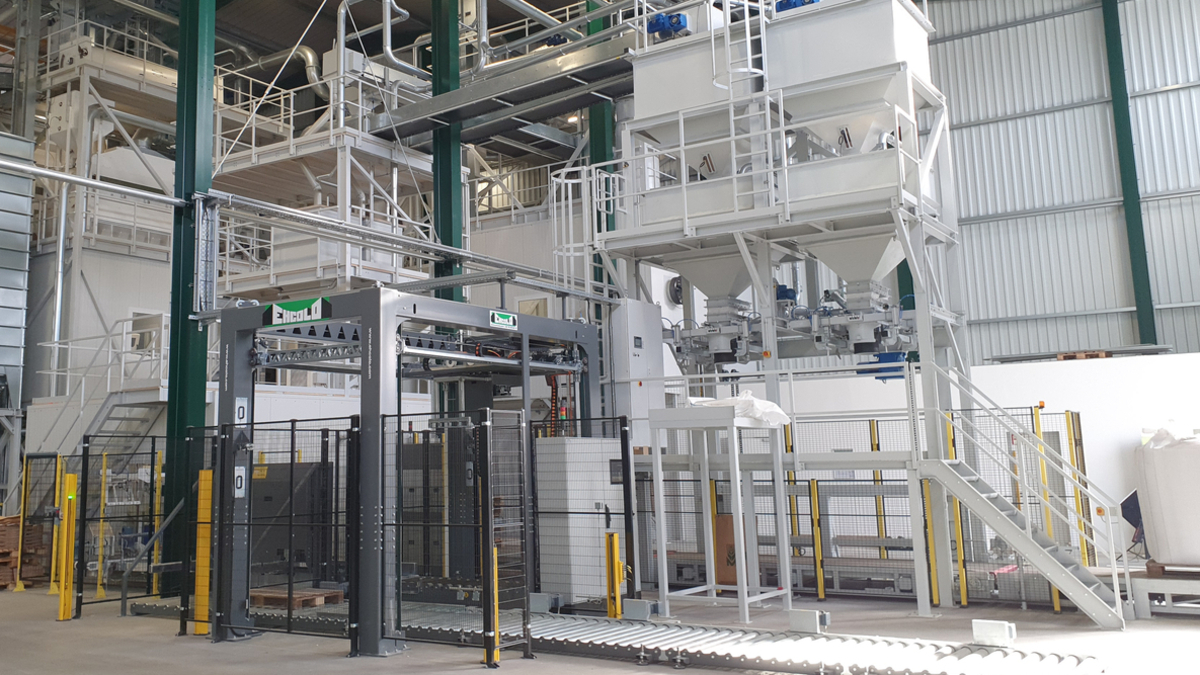
For high bag capacities and industrial packaging lines, portal palletizers are used. They are designed for high availability, stable processes and reproducible pallet patterns.
- high palletizing capacity
- robust industrial design
- precise layer forming
- very uniform pallet patterns
- suitable for continuous high-capacity lines
- integration into automatic pallet conveying systems
- combinable with high-capacity bagging lines
Semi-automatic solutions and ergonomic support
Not every system needs to be fully automatic. For smaller capacities or flexible packaging areas, semi-automatic solutions can be an economical alternative.
- manual palletizing with bag conveyor
- height-optimized operating positions
- turntables or pallet positioners
- vacuum tube lifters for ergonomic bag handling
- simple pallet conveying technology
- semi-automatic wrapping technology
These solutions reduce physical strain and improve operator comfort without requiring a fully automated line.
Pallet handling and conveying technology
Palletizing and wrapping are integrated into the complete system via suitable pallet conveying technology. Depending on the degree of automation, empty pallets can be supplied automatically, loaded pallets transported and finished pallets transferred to dispatch or warehouse logistics.
- empty pallet magazine
- pallet dispenser
- roller conveyors
- chain conveyors
- turntables
- transfer units
- pallet centering
- transfer sections
- buffer positions for finished pallets
- interfaces to forklift traffic or warehouse systems
Pallet wrapping and load securing
After palletizing, finished pallets are secured for storage and transport. Depending on capacity, pallet pattern and dispatch requirements, simple stretch wrappers or automatic high-capacity wrapping systems can be used.
- semi-automatic stretch wrappers
- automatic turntable wrappers
- rotary arm wrappers
- ring wrappers for high capacities
- top sheet applicators
- edge protection
- pallet strapping
- film application and cutting systems
- automatic film change
- integrated pallet conveying technology
Automation as a response to labor shortages
Palletizing and wrapping are among the most physically demanding areas of a packaging line. Automated solutions significantly reduce manual lifting and transport work and help maintain stable packaging processes even when personnel availability is limited.
- reduced personnel requirements
- more ergonomic workplaces
- higher and more stable line capacity
- uniform pallet patterns
- improved load securing
- fewer manual errors
- better planning in shift operation
- higher process reliability